
The 2024–2025 NBA season became a defining chapter not only in Luka Dončić’s career but also in the modern history of the Dallas Mavericks. At an age when many stars are still refining their roles, Dončić delivered a campaign that reshaped statistical expectations and forced opposing coaches to rethink defensive schemes. His performances went far beyond individual brilliance and directly influenced how Dallas structured its offence, rotations, and late-game decision-making.
Historic Individual Records and Statistical Impact
Throughout the season, Luka Dončić consistently led the league in usage rate while maintaining elite efficiency. He averaged over 33 points per game, pairing scoring volume with double-digit assist numbers on a nightly basis. This combination placed him in rare historical company, alongside players such as Oscar Robertson and James Harden, yet with a higher true shooting percentage than most high-usage guards of previous eras.
One of the most striking elements of Dončić’s season was his scoring versatility. He ranked among the league leaders in step-back three-point accuracy, post-up efficiency against smaller defenders, and points created from pick-and-roll actions. These metrics underline not only raw talent but also an advanced understanding of spacing and timing, crucial in a league increasingly driven by analytical optimisation.
Advanced data further highlighted his dominance. Dončić finished the season near the top of the NBA in Player Efficiency Rating and offensive box plus-minus. These figures confirmed that his impact extended beyond visible highlights, influencing possessions even when he was not directly scoring, through gravity and decision-making.
Consistency Against Elite Competition
Dončić’s production did not dip against top-tier opponents, a factor often separating great seasons from legendary ones. Against teams with top-ten defensive ratings, he maintained scoring averages nearly identical to his season mean. This level of consistency forced playoff-calibre teams to abandon standard defensive coverage in favour of aggressive doubles and early traps.
In nationally televised games and high-pressure matchups, his efficiency often increased rather than declined. This pattern reinforced his reputation as a player whose decision-making sharpens when defensive complexity rises, a trait traditionally associated with all-time great playmakers.
The Mavericks benefited directly from this reliability. Knowing that Dončić could anchor offensive production regardless of opponent allowed the coaching staff to stabilise rotations and manage minutes more strategically across the season.
Tactical Evolution of the Dallas Mavericks’ Offence
Dončić’s expanded skill set pushed Dallas toward a more flexible offensive identity. While previous seasons relied heavily on static pick-and-roll structures, the 2024–2025 campaign introduced more off-ball movement and secondary actions initiated by Dončić himself. He often began possessions without the ball, drawing defenders into early mismatches before reclaiming control.
This tactical shift improved overall spacing. Shooters benefited from cleaner looks as help defenders hesitated longer before committing. The Mavericks’ three-point efficiency rose accordingly, particularly from the corners, an area directly linked to Dončić’s drive-and-kick vision.
The offence also became more adaptable late in games. Instead of relying on predictable isolation sets, Dallas mixed post entries, inverted pick-and-rolls, and delayed actions, all orchestrated through Dončić’s court awareness.
Role Adjustment of Teammates
Several Mavericks players experienced statistical growth due to Dončić’s influence. Secondary ball-handlers saw reduced pressure, allowing them to focus on efficient shot selection rather than creation under duress. This change improved overall offensive rhythm and reduced turnover rates.
Big men, in particular, benefited from Dončić’s precision passing. Roll efficiency and points generated from lob actions increased, reflecting better timing and defensive manipulation. These improvements were not coincidental but the result of deliberate tactical emphasis during the season.
The collective result was a roster that appeared more balanced on paper, even though the offence remained clearly centred around one dominant creator.
League-Wide Influence and Strategic Implications
Dončić’s season also carried implications beyond Dallas. Defensive coordinators across the league increasingly adopted hybrid coverages designed specifically to disrupt heliocentric offences. These schemes, blending zone principles with man-to-man responsibilities, were often tested first against the Mavericks.
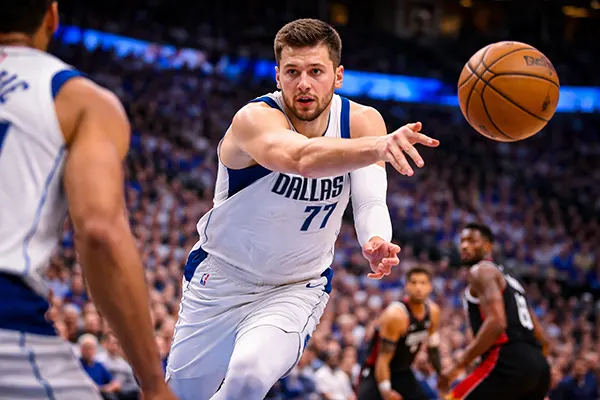
From an analytical perspective, Dončić reinforced the viability of high-usage creators in an era focused on ball movement. His efficiency challenged the assumption that offensive balance must come from equal distribution, instead suggesting that optimal balance can stem from one elite decision-maker.
Younger players entering the league now reference Dončić’s style as a model for combining physical pacing with advanced reads, rather than relying purely on speed or athleticism.
Long-Term Outlook for Dallas
Looking ahead, the Mavericks are positioned to build sustainably around Dončić’s prime years. His durability during the season, coupled with improved conditioning, reduced concerns about long-term workload management.
Front-office decisions increasingly reflect his preferences on spacing, versatility, and basketball intelligence. This alignment between star player and organisational strategy is a critical factor in long-term contention.
If the tactical foundations laid during this season continue to evolve, Dallas has the framework not only to remain competitive but to define an offensive blueprint that other franchises attempt to replicate.