
The 2026 Tour de France was designed to place the general classification under pressure at both ends of the race. It began on 4 July with a 19.6-kilometre team time trial through Barcelona and reaches its decisive weekend with consecutive mountain finishes at Alpe d’Huez on 24 and 25 July. Those choices changed the contest before the final winner was known: the Barcelona opener created measurable gaps immediately, while the Alpine finale prevented every leading rider from treating a single mountain stage as the last serious test. As of the completion of Stage 18 on 23 July, Tadej Pogačar led Remco Evenepoel by 4 minutes 32 seconds, with Isaac del Toro third at 6 minutes 51 seconds and Paul Seixas only 20 seconds further back. The first Alpe d’Huez stage had not yet been raced at that point, so its final effect remained uncertain, but the double finish had already shaped team selection, energy management and the timing of attacks throughout the Tour.
Barcelona Put the General Classification Under Pressure from Day One
The opening stage in Barcelona was more than a ceremonial introduction to the 113th Tour de France. The 19.6-kilometre route began on fast roads near the seafront, crossed broad city avenues and ended with a demanding approach to the Olympic Stadium on Montjuïc. It was the first team time trial in the men’s Tour since 2019 and only the second occasion on which the race’s first yellow jersey was awarded after this discipline. The result therefore carried two forms of importance. A team could earn a prestigious stage victory through collective speed, while its general-classification leader could gain or lose time before the race had reached its first normal road stage. There was no quiet opening week in which favourites could observe one another from the safety of the peloton. Their condition, organisation and confidence were tested in public on the first afternoon.
Team Visma | Lease a Bike handled that pressure best. Jonas Vingegaard crossed the line in 21 minutes 47 seconds, giving his team the stage win and taking the yellow jersey for the first time since his 2023 Tour victory. Filippo Ganna finished eight seconds later for Netcompany Ineos, while Pogačar was third at 12 seconds for UAE Team Emirates XRG. The gaps were small compared with those normally created on a major mountain, but they were meaningful because they established an immediate order among the principal contenders. Vingegaard gained the psychological benefit of leading the race and confirmed that Visma had arrived with a powerful, disciplined group. Pogačar lost only 12 seconds, a manageable deficit, yet he was forced to begin his campaign as the rider chasing rather than controlling yellow.
The Barcelona result also showed why a short opening time trial can have an influence beyond the seconds recorded. Teams had to commit considerable preparation to a discipline that depends on smooth changes of pace, clear communication and riders with different strengths working in one line. Every squad wanted enough powerful rouleurs to survive the high-speed first section, but the final climb favoured leaders who could accelerate when heavier team-mates began to fade. That balance affected Tour selections months before the start. It also affected the first week because riders who had spent heavily in Barcelona still had to manage a hilly second stage, the early Pyrenean finish at Les Angles and further mountain tests. The opening did not decide the Tour, but it removed the option of easing gradually into the race.
Why the New Team Time-Trial Format Mattered
The 2026 format differed from the traditional team time trial in one crucial respect. The stage classification was based on the time of each team’s first rider, while every rider received his own finishing time for the general classification. Under older versions of the discipline, a team’s time was usually taken from a specified rider, which encouraged the strongest members to keep a fixed group together until the line. In Barcelona, a leader could continue alone once his final helpers had completed their work. That rule made the closing climb far more personal. A well-organised team was still essential on the flat roads, but the overall contender had to judge when collective riding had reached its limit and when an individual effort would produce a better result.
Vingegaard and Visma used the format exactly as intended. His team-mates drove the opening kilometres, protected his speed and delivered him to the decisive section with enough energy to finish the job. Pogačar produced the fastest ride over the final hilly 3.7 kilometres and collected the first mountains jersey, demonstrating that UAE’s 12-second loss did not reflect weakness on the climb itself. Netcompany Ineos also came close to victory, although Kévin Vauquelin’s puncture disrupted its plan before Ganna finished eight seconds behind Vingegaard. The outcome rewarded both team strength and individual judgement. It also produced several different stories within one result: Visma won the collective contest, Vingegaard took yellow, and Pogačar showed the strongest climbing finish.
For the yellow jersey contenders, this individual timing changed the risk calculation. A leader who waited too long for struggling team-mates could lose seconds unnecessarily, but a leader who accelerated too early could run out of strength before Montjuïc. Teams also had to decide which riders should sacrifice themselves completely and which should conserve enough energy to remain useful later in the Tour. These decisions were simple to understand from the outside even though they were difficult to execute at racing speed. Barcelona therefore gave spectators an immediate view of each squad’s hierarchy. It showed who was protected, who was prepared to empty himself for a leader and which favourites were capable of finishing strongly after a hard collective effort.
The Yellow Jersey Battle Changed Again Before the Alps
The order created in Barcelona did not remain fixed. Pogačar moved into the lead during the following stages and gradually built a substantial advantage through a combination of climbing strength, consistent positioning and time gained when rivals came under pressure. By the end of Stage 18 at Orcières-Merlette, he had completed 64 hours 35 minutes 13 seconds of racing and held a 4-minute-32-second advantage over Evenepoel. Del Toro, Pogačar’s UAE team-mate, occupied third place at 6 minutes 51 seconds, while the 19-year-old Seixas sat fourth at 7 minutes 11 seconds. Juan Ayuso was fifth at 9 minutes 22 seconds. This meant the final Alpine weekend contained two different contests: Evenepoel still needed a major reversal to challenge for yellow, while the fight for the remaining podium places was separated by far smaller margins.
The most important change came on Stage 15 to Plateau de Solaison. Vingegaard, who had begun the Tour in yellow and had been central to the expected battle with Pogačar, crashed with 24 kilometres remaining and left the race. It was his first withdrawal in six Tour appearances after five consecutive overall podium finishes. Evenepoel won the stage ahead of Pogačar and Del Toro, then moved into second place overall. The withdrawal altered the logic of the race. Pogačar no longer had to manage the repeated attacks and tactical strength of a Visma leader who had defeated him in previous Tours. Evenepoel became the nearest challenger, but he faced a much larger deficit and a different problem: he had to find time against the strongest rider in the race rather than merely defend a podium position.
Evenepoel gave himself a better chance in the Stage 16 individual time trial from Évian-les-Bains to Thonon-les-Bains. He won the 26.1-kilometre test in 32 minutes 19 seconds and beat Pogačar by 28 seconds, reducing the overall gap to 4 minutes 32 seconds. That performance confirmed his form and reminded UAE that the leader could not afford a serious mistake. Stage 18 produced a different type of race. Richard Carapaz won alone at Orcières-Merlette, 45 seconds ahead of Mauro Schmid and Matteo Jorgenson, while the main general-classification group avoided a major confrontation. Pogačar retained the same advantage over Evenepoel. The apparent calm was important because it allowed the leading riders to preserve energy before two much harder days at Alpe d’Huez.
Why a Four-Minute Lead Is Strong but Not Absolute
A lead of more than four minutes with three stages remaining is normally a commanding position, especially when the rider in yellow has already proved to be the strongest climber in the race. Pogačar does not need to attack to win the Tour. He can follow Evenepoel, allow breakaway riders to contest stage honours and use his team to keep the race controlled. Yet a long mountain weekend can turn a manageable problem into a large time loss. Fatigue accumulates after nearly three weeks, support riders can be dropped early, and a poorly timed effort can leave a leader isolated many kilometres from the finish. Crashes, punctures and illness also remain part of stage racing. The advantage is strong because it gives Pogačar room to respond calmly, not because it removes every possible danger.
Evenepoel’s task is harder to define because small gains are not enough. The time bonuses of 10, six and four seconds at the finish cannot close a gap measured in minutes. He needs to create separation on the road and maintain it over a sustained period. Stage 19 offers a possible test because its short distance encourages a fast start, while Stage 20 provides much longer climbs on which a rider can lose contact well before the final approach. Evenepoel’s time-trial victory showed that his condition remained excellent, and his win at Plateau de Solaison proved that he could stay with Pogačar on a severe summit finish. However, winning yellow requires more than matching the leader. He must force Pogačar into a difficult moment and then convert that weakness into several minutes.
The margins behind Evenepoel make the podium contest more open. Del Toro and Seixas were separated by only 20 seconds after Stage 18, so one acceleration, one difficult descent or one moment without team support could reverse their positions. Del Toro also has to work within UAE’s main objective of protecting Pogačar. He cannot always respond freely if doing so would weaken the yellow jersey group. Seixas has more tactical freedom, but he carries the physical demands of his first Tour at only 19 years of age. Ayuso remained 2 minutes 31 seconds behind Del Toro and 2 minutes 11 seconds behind Seixas, a sizeable gap but one that could disappear on the penultimate stage. For these riders, the double Alpe d’Huez finish is not simply about stage victory; it is the final opportunity to define the podium and the best young rider classification.
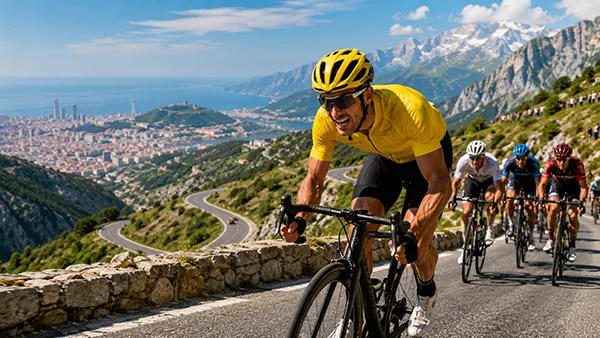
Two Alpe d’Huez Finishes Turn the Final Weekend into One Test
Stage 19 from Gap to Alpe d’Huez is short at 127.9 kilometres, yet it contains 3,500 metres of climbing and begins to rise almost immediately. The riders face the 4.8-kilometre Col Bayard at 7.2 per cent, followed by the harder Col du Noyer, which averages 8.5 per cent for 7.2 kilometres. After a long middle section, the route climbs the Col d’Ornon before reaching Bourg-d’Oisans and the familiar road to Alpe d’Huez. The final ascent is 13.7 kilometres at an average of 8.1 per cent and includes the 21 hairpin bends that have defined many Tour battles. Because the stage is relatively short, there is little time for the peloton to settle. An aggressive team can increase the pace early, reduce the number of helpers and make the last climb a direct contest between leaders.
Stage 20 is a different challenge. It covers 170.9 kilometres and has 5,450 metres of elevation gain, making it the largest mountain stage of the 2026 Tour. The route begins with the 24-kilometre Col de la Croix de Fer, continues over the Col du Télégraphe and reaches the 2,642-metre Col du Galibier, the highest point of the race. The riders then face the Col de Sarenne, a 12.8-kilometre climb at 7.3 per cent, before approaching Alpe d’Huez from the less familiar side. The Tour used the Sarenne road as a descent in 2013, but the 2026 route turns it into the final major ascent. This changes the character of Alpe d’Huez. The decisive damage may occur before the television images reach the famous hairpins, on exposed high-altitude roads where fatigue and limited team support can create much larger gaps.
Placing these stages on consecutive days changes how every contender must use his strength. A rider who attacks repeatedly on Friday may gain time but pay for the effort on Saturday’s longer and higher route. A rider who remains conservative on Stage 19 may preserve energy, yet he could also miss the easiest chance to isolate a rival before the classic ascent. The yellow jersey team must control two very different races: a short, sharp stage in which attacks can begin early and a penultimate-day endurance test with four major climbs. Challengers must decide whether to spread their efforts across both days or commit to one decisive move. This is why the double finish reshaped the yellow jersey battle even before the results were known. It turned the final weekend into a connected two-day examination rather than two independent stages.
What Each Main Contender Must Do
Pogačar’s best strategy is controlled defence rather than unnecessary domination. His 4-minute-32-second lead allows UAE to let non-threatening breakaway riders gain space while keeping Evenepoel and the other general-classification contenders close. On Stage 19, a steady tempo before Alpe d’Huez can discourage long attacks and preserve helpers for the final climb. On Stage 20, the team must avoid spending every rider on the Croix de Fer because the Télégraphe, Galibier and Sarenne come later. Pogačar can afford to concede a modest amount of time, but he should not allow a rival to begin the final climb with a large advantage. His greatest asset is not only his lead; it is the fact that the others must attack him, allowing him to choose which moves deserve an immediate response.
Evenepoel needs to make the race less predictable. Waiting until the final kilometre would provide a chance of another stage win but almost no chance of taking yellow. His strongest option is to use his team to increase the pace before the last ascent, isolate Pogačar and test whether UAE can still control the race after three demanding weeks. Stage 19 can reveal whether the leader has any weakness, while Stage 20 offers the distance required for a larger move. Evenepoel must still avoid attacking so early that he spends too much energy alone on open roads. The most effective moment would be one created by existing pressure: after a hard climb, during a reduced section in which Pogačar has few helpers, or when another podium contender attacks and forces UAE to make a rapid decision.
Del Toro, Seixas and Ayuso have different priorities but may influence the yellow jersey contest. Del Toro must protect third place while supporting Pogačar, a difficult combination if Seixas attacks when the UAE leader is already under pressure. Seixas can target the 20-second gap directly and may benefit if the two UAE riders are required to defend separate objectives. Ayuso needs a larger gain, so he is more likely to profit from an ambitious move before the final climb. Their attacks could force Pogačar or Evenepoel to use team-mates earlier than planned, indirectly changing the main battle. The final outcome will be decided on the road, but the central lesson of the 2026 route is already clear: Barcelona made every second count from the first day, and the two approaches to Alpe d’Huez ensure that no advantage can be treated casually before Paris.