
The 2026 UCI Road World Championships have reached their decisive road-racing phase in Montréal after three days devoted to individual and team time trials. As of 24 September, several rainbow jerseys have already been awarded, with Remco Evenepoel producing the standout result by retaining the Men Elite individual time-trial title and extending an unprecedented winning sequence in the discipline. The Belgian completed the opening Sunday with his fourth consecutive world time-trial crown, while Marlen Reusser successfully defended the equivalent women’s title. Attention now turns to the road races around Mount Royal, culminating in the Women Elite race on Saturday, 26 September and the Men Elite race on Sunday, 27 September. Montréal is hosting the championships from 20 to 27 September, bringing the event back to a city with a significant place in road cycling history and giving many of the leading riders another opportunity to compete for the rainbow jersey before the week ends.
Remco Evenepoel Makes History in the Montréal Time Trial
Remco Evenepoel arrived in Montréal as the defending Men Elite individual time-trial world champion and left the 39.2-kilometre course with another rainbow jersey. Racing on 20 September, the Belgian completed the route in 44 minutes 53.13 seconds, averaging approximately 52.4 km/h. The course required more than sustained speed on long open sections. Riders also had to manage a more technical opening and finish, while the central part rewarded those capable of maintaining high power for an extended period. Evenepoel was the final rider to start and recorded the fastest time at every official checkpoint. By the time he reached the finishing straight near Jeanne-Mance Park, his advantage was large enough for him to ease slightly and celebrate before crossing the line. The result confirmed that the title he first won in 2023 would remain with him for another season.
Filippo Ganna provided the closest challenge, but the Italian finished 57 seconds behind Evenepoel and took silver. France’s Paul Seixas added another notable result to his rapid progression by claiming bronze at 1 minute 13 seconds, only days before his twentieth birthday. Sweden’s Jakob Söderqvist had also been producing a competitive ride before crashing on a bend and eventually finishing fifth. In a discipline where small differences can usually separate the leading specialists, Evenepoel’s margin was substantial. His victory was not simply another successful title defence: it made him the first male rider to win the elite individual time-trial world championship in four consecutive years. The sequence began in Stirling in 2023, continued in Zürich in 2024 and Kigali in 2025, and has now been extended to Montréal in 2026.
The result also changes the context in which Evenepoel approaches the Men Elite road race on 27 September. He is already a former road world champion, having won the rainbow jersey in 2022, and he demonstrated at the Paris 2024 Olympic Games that he can win both the individual time trial and road race at the same major event. Montréal therefore gives him another chance to pursue two major victories during the same championship week, although the road race presents a completely different challenge. Instead of riding alone against the clock, Evenepoel will compete within the Belgian national team across 273.7 kilometres of repeated climbing, changing race situations and attacks from several nations. His time-trial performance confirms his form, but it does not remove the tactical uncertainty that makes a World Championship road race so different from an individual test.
Reusser and the Other Time-Trial Champions
Marlen Reusser completed another successful title defence in the Women Elite individual time trial earlier on the same day. The Swiss rider covered the same 39.2-kilometre Montréal course in 50 minutes 24.44 seconds and secured her second consecutive elite world title. Great Britain’s Zoe Bäckstedt started strongly and held the advantage during the opening portion of the race, but Reusser managed her effort effectively and was strongest during the later kilometres. Bäckstedt finished a little more than 40 seconds behind and earned silver, while Germany’s Franziska Koch took bronze. For Reusser, the victory brought a fifth World Championship medal in the individual time trial: two gold medals, two silvers and one bronze. It was also achieved on her 35th birthday, adding another distinctive detail to the opening day of competition in Montréal.
The Under-23 time trials followed on 21 September and produced two different stories. Australia’s Felicity Wilson-Haffenden won the Women Under-23 event over 20.3 kilometres, finishing 28 seconds ahead of Dutch rider Nienke Vinke, with Belgium’s Luca Vierstraete taking bronze. Wilson-Haffenden completed the course in 27 minutes 40.72 seconds and added another rainbow jersey to titles she had previously earned at junior level and in the mixed relay. In the Men Under-23 event, Ryan Gal delivered a late surge over the 31.2-kilometre route to give the Netherlands the title. He stopped the clock at 37 minutes 26.16 seconds, beating Italy’s Nicolas Milesi by just over seven seconds and Spain’s Héctor Álvarez Martínez by just under twelve. Those close margins contrasted sharply with Evenepoel’s more commanding advantage in the elite race.
The time-trial programme concluded on 22 September with three further titles. Italy won the team time trial mixed relay through Mattia Cattaneo, Filippo Ganna, Matteo Sobrero, Vittoria Guazzini, Elisa Longo Borghini and Monica Trinca Colonel. The Italian six completed the two-part course in 51 minutes 32.28 seconds, ahead of France and Switzerland, giving Italy its first world title in this event after several previous podium finishes. Spain’s Benjamín Noval Suarez then won the Men Junior individual time trial, beating Belgium’s Vic De Smet, while Poland’s Maria Okrucińska claimed the Women Junior rainbow jersey ahead of Belgium’s Yana Decruyenaere. With those races completed, all seven time-trial titles on the Montréal programme had been decided, allowing the championship to turn fully towards four days of road racing.
Mount Royal Will Define the Road-Race Phase in Montréal
Montréal is not an unfamiliar setting for major international cycling. The city previously hosted the Road World Championships in 1974, an edition remembered both for its sporting importance and for being the first staging of the championships outside Europe. Eddy Merckx won the Men Elite road race that year, completing a season in which he had also won the Giro d’Italia and Tour de France. Canada later hosted the championships in Hamilton in 2003, making the current Montréal edition the third Road World Championships held in the country. The 2026 event also coincides with the year marking the fiftieth anniversary of the Montréal 1976 Olympic Games. Modern professional cycling has maintained a regular connection with the city as well: the Grand Prix Cycliste de Montréal has been held since 2010 and uses many of the roads that now form the decisive part of the World Championship routes.
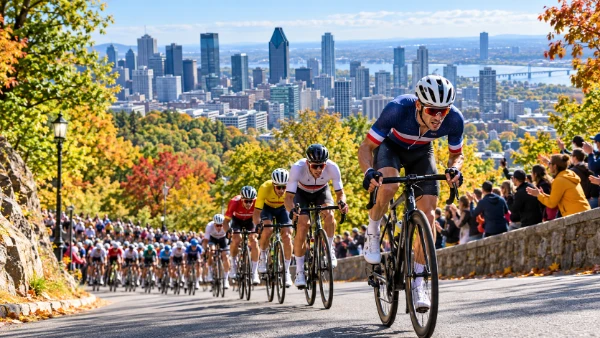
The central feature of the road races is a 13.4-kilometre circuit around Mount Royal containing approximately 269 metres of climbing per lap. Its main sustained ascent is Voie Camillien-Houde, listed by the UCI at 1.67 kilometres with an average gradient of 7.4 per cent and sections reaching 10 per cent. That climb alone would not normally determine a major championship, but its repeated appearance changes the difficulty considerably. Chemin de la Polytechnique provides another important test, including sections above 11 per cent, while the rising approach along Avenue du Parc adds one final demand before the finish. Riders therefore face several opportunities to attack on every lap rather than one isolated decisive climb. As the kilometres accumulate, the same roads that appear manageable early in the race are likely to become considerably harder for riders who have already spent hours responding to accelerations and positioning battles.
The road-race programme begins on Thursday, 24 September with the Women Under-23 and Men Junior events. The Men Under-23 and Women Junior races follow on Friday, before the two elite events occupy the final weekend. The younger categories race entirely on the Mount Royal circuit, giving spectators an early indication of how repeated climbs and the final approach may influence racing. The elite fields have longer opening sections before entering Montréal and beginning their circuits, creating a different rhythm. Early breakaways may form well before Mount Royal, while national teams have to decide how much energy to spend controlling them before the repeated climbs begin. Because the championship is decided in a single race rather than through accumulated results over several stages, tactical decisions made several hours from the finish can still have a significant effect on who remains in contention during the last laps.
The Women Elite Race Covers 180.4 Kilometres and Eight Final Laps
The Women Elite road race takes place on Saturday, 26 September, with the scheduled start at 9:00 local time. Riders will leave from Quartier DIX30 in Brossard and travel towards Montréal before completing eight laps of the Mount Royal circuit. The complete route measures 180.4 kilometres and contains approximately 2,570 metres of elevation gain, with the finish at Parc Jeanne-Mance on Avenue du Parc. Those figures make the race demanding without turning it into a conventional mountain event. The decisive question is likely to be how the field responds to the repeated climbs rather than how riders handle one exceptionally long ascent. Eight passages over the principal difficulties create opportunities for gradual selection, and teams that reach the final laps with several riders still present will have more tactical options than those reduced to a single leader.
Demi Vollering arrives among the prominent names after a strong 2026 season that included success in the Ardennes and victory at the Tour de France Femmes. The Dutch rider is well suited to repeated climbing and prolonged one-day efforts, although a World Championship race requires careful management of rivals from many different national teams. Belgium can look to Lotte Kopecky, winner of the elite road world title in both 2023 and 2024. Kopecky therefore has recent experience of managing the particular pressures of a World Championship finale. Canada has a defending champion of its own in Magdeleine Vallières Mill, who won the Women Elite road race in Kigali in 2025. Racing for another rainbow jersey in her home country gives the Canadian team a very different situation from the one it faced a year ago, when Vallières Mill was not carrying the expectations attached to a reigning world champion.
The route leaves room for several types of rider because the climbs are repeated rather than exceptionally long. Strong climbers can attempt to increase the pace on Camillien-Houde and reduce the size of the group, while riders with a sharper acceleration may prefer the shorter, steeper sections around Polytechnique. Others will try to conserve energy for Avenue du Parc if a small group remains together. That variety is important because there is no requirement for the race to follow one predictable pattern. A breakaway could force major nations to work earlier than planned, repeated attacks could remove teammates from the front group, or a compact selection could remain intact until the final kilometres. The accumulated 2,570 metres of climbing should make freshness increasingly important as the race progresses, particularly after several consecutive laps at championship pace.
The Men Elite Road Race Brings an Open Battle on 27 September
The Men Elite road race closes the championships on Sunday, 27 September. It begins at Quartier DIX30 in Brossard and covers 273.7 kilometres with approximately 3,803 metres of climbing before the finish beside Parc Jeanne-Mance. After the approach to Montréal, the riders complete twelve laps of the 13.4-kilometre Mount Royal circuit. That means Camillien-Houde, Polytechnique and the rising Avenue du Parc approach will recur deep into a race that is already unusually long. One major name will not be defending the road title: 2025 world champion Tadej Pogačar is absent from Montréal following the injuries he suffered in a crash at the Vuelta a España. His absence means the Men Elite rainbow jersey will change hands in 2026 and also removes the rider who had occupied the centre of many major one-day races during recent seasons.
Evenepoel enters the road race with a fresh rainbow jersey from the time trial and considerable championship experience, but the field includes several riders whose recent performances suggest different ways the race could develop. Mexico’s Isaac del Toro won the 2026 Grand Prix Cycliste de Montréal on roads closely related to the World Championship finale, finishing ahead of France’s Paul Seixas. That result gives both riders recent experience of racing at high intensity on Mount Royal. Seixas has since added a bronze medal in the World Championship time trial. Belgium also has Wout van Aert in its selection, while former world champion Mathieu van der Poel represents the Netherlands and Tom Pidcock gives Great Britain another rider with experience on demanding one-day courses. Their presence means that Belgium, despite Evenepoel’s form, cannot plan the race around a single obvious rival or a single expected moment of attack.
The final twelve circuits should place as much pressure on judgement as on climbing ability. Attacking too early can leave a rider isolated for a long distance, but waiting until the final lap carries its own risk if a strong group has already escaped. The long overall distance also distinguishes the World Championship from shorter races that use similar roads. Riders who appeared comfortable during the first passages of Camillien-Houde may respond very differently after more than 200 kilometres, particularly if several national teams repeatedly increase the pace. For Evenepoel, the road race is a chance to add to his 2022 world road title and repeat the time-trial and road-race double he achieved at the 2024 Olympics. For Del Toro, Seixas, Van Aert, Van der Poel, Pidcock and the other contenders, Montréal offers the same rainbow jersey but a very different tactical route towards it.
What to Watch as the Championships Reach Their Final Weekend
The contrast between the completed time trials and the coming road races is one of the defining features of this championship. In the individual time trial, a rider’s result depends primarily on his or her own pacing, speed and handling over a fixed route. The road races introduce teammates, breakaways, repeated attacks and decisions about when to follow or conserve energy. Evenepoel’s performance on 20 September established that he is in strong form, but the 273.7-kilometre road race asks different questions from a 39.2-kilometre effort against the clock. The same applies to Reusser and the other riders transferring from the time trials to the road events. A successful opening part of the week can provide confidence, yet every competitor effectively begins again once the bunch starts together.
The Women Elite race on 26 September and Men Elite race on 27 September will also provide the clearest test of the Mount Royal course. The women face eight final circuits and 2,570 metres of climbing; the men face twelve circuits and 3,803 metres. Camillien-Houde is expected to be the most consistent point of pressure, but Polytechnique and the final rise on Avenue du Parc give riders alternatives if an attack on the longer climb does not create enough separation. Recent racing in Montréal has already shown that the circuit can reward climbers and aggressive one-day specialists. The World Championship adds a longer distance, national-team tactics and the importance of a rainbow jersey, making it difficult to treat the preceding Grand Prix as a direct prediction of what will happen during the final weekend.
By 24 September, Montréal 2026 has already produced a historic fourth consecutive elite time-trial title for Evenepoel, another world title for Reusser, new Under-23 champions and Italy’s first victory in the mixed relay. The central road-racing part of the programme is only beginning. Over the remaining four days, Junior, Under-23 and Elite riders will repeatedly return to Mount Royal, with the two longest and most closely followed races reserved for the weekend. The championship therefore moves from a phase in which seconds and precise individual performances determined the rainbow jerseys to one in which endurance, timing and team decisions will become increasingly important. Fifty-two years after Montréal first hosted the Road World Championships, the city’s most recognisable cycling roads are again set to decide who leaves Canada wearing the elite road-race rainbow jerseys.